
The Hitchhiker
by Rachel L. Perrino
The Ixodes scapularis, or the black-legged deer tick, doesn’t just bite; it anchors. It secretes a cement-like substance to stay put, and a local anesthetic to ensure the host misses the intrusion. It is a masterclass in biological gaslighting—a way for the intruder to feast in a silence that, in my case, lasted over a month.
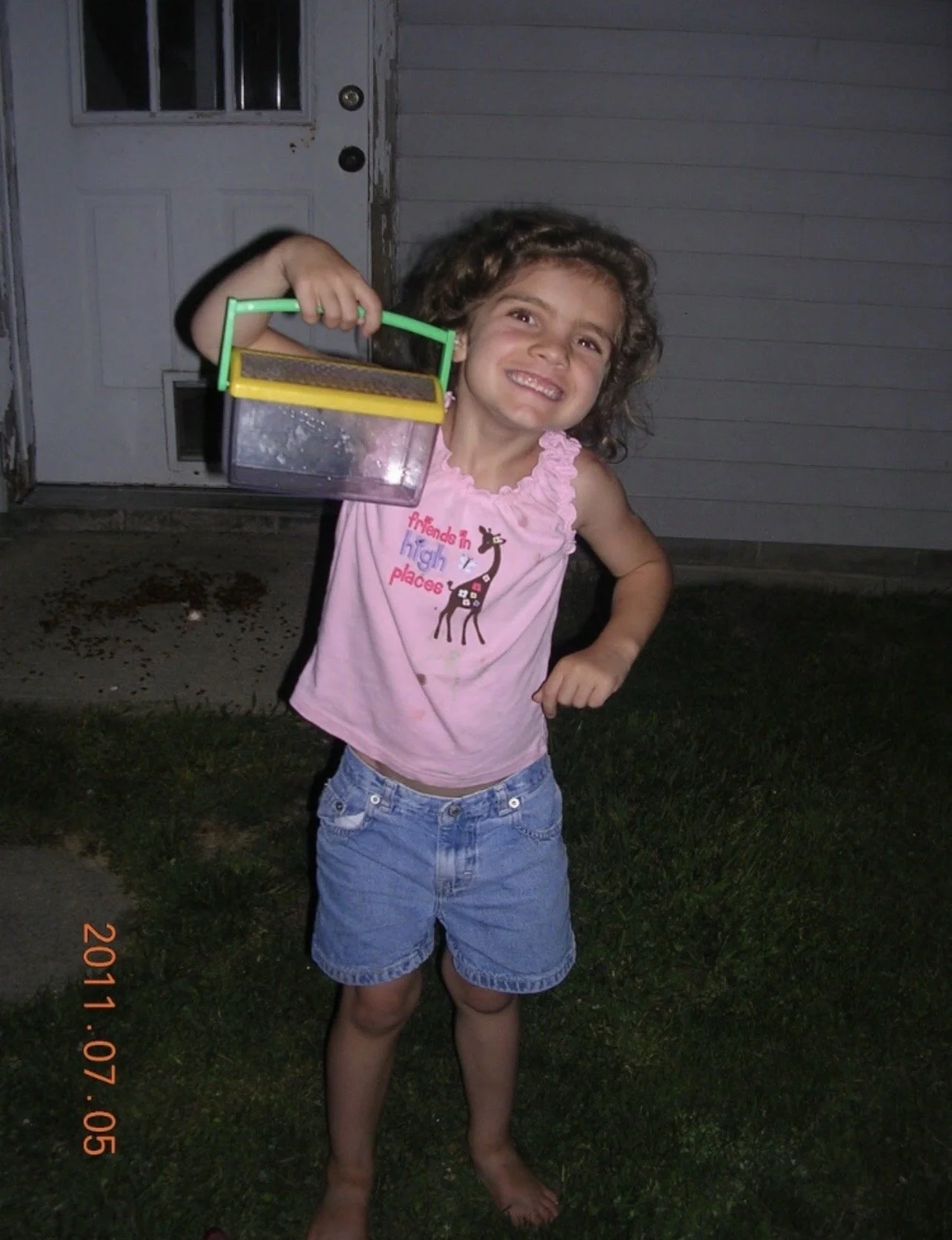
The summer of 2011 was a tropical anomaly. On our annual road trip to Florida, my family stopped in Cincinnati, where a record-breaking heatwave turned the Ohio landscape into a humid, waist-high jungle. At five, I was oblivious to the 48°C heat index; to me, this was a playground. I stood outside a white farmhouse with dirt-caked feet and a tangled crown of hair, grinning as I hunted for whatever crawled into my plastic “bug jail,” unaware that, in the steam of the meadow, roles were being reversed.
Ticks thrive in the intersection of heat and dampness, and that July, Cincinnati saw its fourth-wettest month on record. Moisture turned the meadow into a biological incubator where the Ixodes weren’t just surviving—they were thriving, multiplying in the shadows.
As a Canadian, this was my first Fourth of July—a spectacle of sticky cupcakes and fireworks. The noise was too much; I sat on my dad’s lap in the tall grass while his hands cupped my ears. Watching electric sparks against the pitch-black sky, I felt untouchable, unaware that the threat wasn't the explosions above, but insect legs in the grass we sat on—front legs stretched out, drawn by the heat of a passing body.
That year, I was their target.
It’s no mystery as to where this tick was picked up, but when? How?
Perhaps it happened while I was chasing the cat. I would wait for that ball of grey and brown to scurry through the kitty door and into the scratchy depths of the hedges. I remember crawling deep into the bush, cornering the creature just to feel the softness of its coat.
Ticks are blind but hypersensitive to exhaled carbon dioxide and radiating heat. They do not jump; they lurk on shrubs, waiting for a pulse of warmth. In the shrub’s shadows, I was a glowing thermal target. Unlike mosquitoes, ticks are relentless, twenty-four-hour opportunists. When I pressed my scalp against the leaves, I was perfectly in range.
Perhaps it latched onto me under the cover of the Ohio night as I sprinted through darkness alongside my older sisters and our American friends—Bryce, Tatum, and Brock—our flashlights slicing through the humid air like lightsabers.
Flashlight tag was our nightly ritual: a high-stakes game of reaching "base," a wooden play structure, without being caught in a beam of light by the seeker. To stay hidden, I’d belly-crawl through damp undergrowth. Nearby, the orange glow of a campfire flickered where our parents sat. Brock and I, the youngest, were joined at the hip—two small shadows navigating the weeds. We were equal targets, but biologically, I was the more inviting host. Brock sported a blonde buzz cut; I had a dark thicket of ringlets.
We pressed our scalps into the bushes to avoid the flashlight beams, and unknowingly, I was offering the ticks sanctuary. I remember the thrill of the dry stalks whipping against my shins—the bliss of being five and fast.
“You were absolutely wild,” my mom jokes now.
The tick was no visitor; it was a tenant, fusing itself to me with a permanence that blurred the line between parasite and person. I look back at that photo—five-year-old me, sun-browned and ferally happy—squinting at the screen. A nymph-sized Ixodes is no larger than a poppy seed, but I can’t see the dark speck in the photo.
Regardless of the exact moment it latched on, by the time we piled into our 2005 Honda minivan, the hitchhiker was secured.
The drive to Florida was a blur of Dramamine-induced drowsiness. For the sake of a peaceful trip, my mother knocked us out with this American-brand motion sickness medicine.
“That shit was awesome. Knocked you guys right out,” my mom chuckles.
When I wasn’t asleep, I was a captive audience. My sisters, Emily and Annika, always won the movie battle, scoffing at my requests for Barbie. We’d pull on bulky headphones and stare at the portable DVD player for hours. I vividly remember watching A Bug’s Life—a bitter irony to recall now: watching a cartoon about talking insects while a real-life antagonist cemented itself into my scalp and began a silent, weeks-long feed. The days in Clearwater, Florida, are memories of sun-drenched bliss. Hours in the pool, my dad launching me through the air until my skin was pruney. Afternoons when the heavy Atlantic waves whipped me beneath the surface, their current dragging me under. Perhaps a terrifying experience for some, but for me, it was electrifying.
“You were in the water for hours every day,” my mom says, her voice trailing off. “And that thing stayed on. Somehow, it stayed on.”
Ixodes does more than bite, it hooks. Its barbed mouthparts act like a harpoon, secreting a waterproof biological glue designed to survive chlorine, salt, and the frantic splashing of a kid. It had become a permanent fixture in the dark forest of my hair.
With the obliviousness of the very young, I climbed the ledge of our 20th-floor balcony to spot manatees in the aqua water below. I leaned against the glass until I heard my dad’s frantic voice: “Rachel, get down!”
But danger was already here. Embedded. It showed up first as a “sore spot” punctuating highlights of the trip. A sore spot that burned when I stretched goggles over my head and throbbed when I was snorkeling at dolphin camp—an experience I remember so clearly because the pressure of the mask dug into my scalp as we swam with Winter, the famous rescue dolphin with a prosthetic tail.
The delay was biological. Masters of chemical camouflage, ticks inject antihistamines and anticoagulants to stay undetected. By week three, the Ixodes had reached its rapid engorgement phase. No longer a microscopic secret, its physical weight stretched my scalp, triggering an inflammatory response no amount of natural anesthetic could mask.
The morning we left for Universal, my mother brushed my hair in the humid, pale-blue bathroom. As the bristles hit my scalp, I squeaked, “Ow, Mummy. That’s my sore spot.”
“I thought you were dying,” she tells me years later, recalling the moment she parted my hair and found it. “I thought you had a tumor,” her eyes wide as she recalls the discovery. There, on my scalp, sat a bloated, leathery sphere the size of a grey grape.
It no longer looked like an insect. In its final feeding stage, the Ixodes undergoes a radical transformation: its chitinous shell stretches until it is translucent and leathery, mimicking the beige-grey hue of human tissue. With legs tucked beneath the swell and its head fused by biological cement, it looked less like a parasite and more like a mutation.
We went to Universal anyway. In photos, I grin beside the Lorax, oblivious to the "grey grape" beneath a ringlet. “You didn’t let me put your hair up,” my mother claims. “It hurt.” I feared the animatronic monsters in the park while a real one ballooned on my scalp. I remember magic; I wonder if my mother saw a dying girl and struggled with her fear.
She kept her terror a secret, a burden carried through the long drive back to Canada. I was small, oblivious to the fact that my "sore spot" was now a medical emergency.
McMaster Children’s Hospital was a blur of waiting rooms with sunshine and trees painted on the wall. I remember lying on a high bed, surrounded by a half-dozen lab coats. Doctors were looming over me like I was a medical marvel. To them, I was an interesting case. As for me, by now I was simply terrified.
The doctor counted down from three to pry the “leech” from my scalp. The pain was sharp; a screech burst out of me, but then I was freed. They showed me what they’d ripped from me. I stared in disbelief. It was the size of a toonie.
Behind the wall of doctors, my mother endured a different agony. She’d just learned the "tumor" was a tick. That Ixodes scapularis had been harvesting my blood for weeks. Doctors told her the statistics: in 2011, the black-legged tick was aggressively expanding through the Ohio River Valley, turning our vacation pitstop into a breeding ground for Lyme disease.
Waiting for the lab results, my mother was trapped in a clinical haunting.
Lyme Disease: While the erythema migrans rash usually signals infection within seven days, we were thirty days in the danger zone, where bacteria migrate to joints and the nervous system. Because the bite was hidden, we had unknowingly spent the summer in a dangerous countdown.
I felt fine, even asking to go to the park after the extraction, oblivious to the clinical stakes: risks of chronic arthritis, facial palsy, cognitive impairment—damage that antibiotics might never reach. Even if caught at thirty days.
For two weeks, my parents lived in suspense. My mother aggressively monitored my gait, temperature, and speech, searching for signs the bacteria had crossed the blood-brain barrier.
When the results came back negative, the relief was a huge weight lifted. I started Grade 1 that September with a clean bill of health, a story, and a mauve scar hidden under my hairline.
We survived the summer, but my mother still carries the biological echo of what almost was.
End Notes
“July 2011 Breaks Records.” National Weather Service, National Oceanic and Atmospheric Administration, 1 Aug. 2011, www.weather.gov/cle/event_201107_climate
“Lyme Disease.” Mayo Clinic, Mayo Foundation for Medical Education and Research, 7 Dec. 2024,
www.mayoclinic.org/diseases-conditions/lyme-disease/symptoms-causes/syc-20374651
“Lyme Disease Surveillance Data.” Centers for Disease Control and Prevention, U.S. Department of Health and Human Services, 2011, www.cdc.gov/lyme/stats/index.html
“Tick Bites: Learn More – What Are Ticks and How Can They Be Removed?” InformedHealth.org, Institute for Quality and Efficiency in Health Care (IQWiG), 15 May 2025, www.ncbi.nlm.nih.gov/books/NBK279240/.
Rachel Perrino is an author from Burlington, Ontario, currently pursuing a major in English at Wilfrid Laurier University. Her creative work often explores the intersections of childhood and personal memory through a lens of psychological inquiry. Outside of her studies, she is an avid boulderer and hiker, as well as a dedicated swim instructor and lifeguard. The piece presented in Held Magazine marks her debut publication.